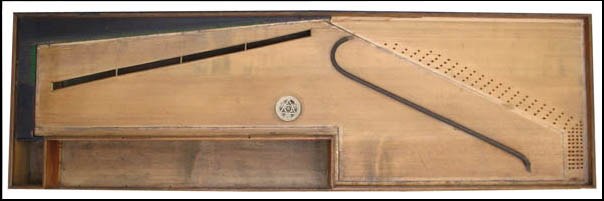
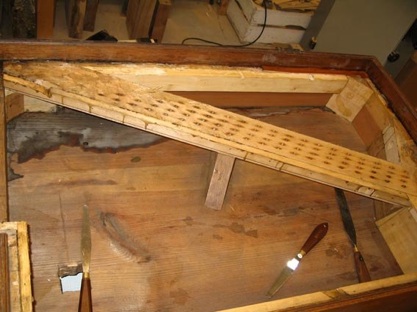
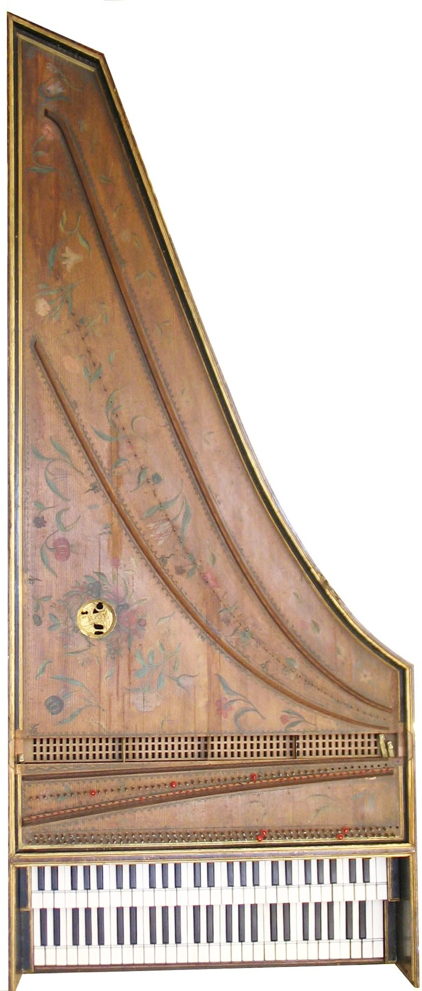
From 2005 to 2010 I did extensive research on the condition of several keyboard instruments from the collection of musical instruments in the Gemeentemuseum, The Hague, now named Kunstmuseum. From 2007-10 I restored both the 1783 clavichord by Straube, the 1589 Celestini spinet and the 1669 Couchet harpsichord, as well as making a copy of the former.

The harpsichord signed 'PETRVS IOANNES COVCHET ME FECIT ANTWERPIAE' (collection Rijksmuseum, Amsterdam), is dated 1669 on the soundboard. Originally it was a single manual instrument with a range of C to c3 chromatically, one set of strings at 8-foot pitch and one set of strings at 4-foot pitch, but with two sets of jacks for the 8-foot, plucking the same string. At some point a second choir of 8-foot strings was added. Around the middle of the 18th century the harpsichord was enlarged. This was probably done in Amsterdam, either by Friederich Laescke or Jan Christoffel Smit, or by an anonymous maker working in the same style. The case was widened and the compass was extended up to f3. The wrest plank, the cheek and the spine were extended to make room for a second keyboard. The bridge was re-pinned, the nut replaced, new keyboards and jacks were made and the new disposition became 8' 4' 8', dogleg and a lute on the upper manual. The lid was enlarged, retaining the original paper on the inside, a new stand with cabriole legs was made and the instrument was painted in an imitation of walnut, something that seems typical for instruments made in Amsterdam in the second half of the 18th century.
During my restoration I removed a part of the bottom board which revealed that the original bentside was still in place. It had been planed down on the outside and a piece of oak was glued to it to form the extension. The new bentside end was dovetailed to the original cheek. The upper and lower belly rails were replaced by a heavy, composite belly rail of spruce in the style of Laescke and Smit. The liner, hitchrail and the inner part of the bentside above the hitchrail were simply extended. A brace was nailed to the lower surface of the liner joint to support it. Unfortunately the glue joints had failed. The new hitchrail had moved forward, taking the liner and part of the bentside with it.
Almost all of the 18th Century jacks were there and many still had original dampers. They are made of starched woolen cloth with a rounded edge. These dampers work very differently from the modern felt flag dampers. They more or less fold themselves towards the strings and damp the sound gradually. When the register is disengaged the strings are undamped.
There is no doubt anymore about the authorship of the instrument. Several 17th and 18th century documents prove that the second son of Ioannes Couchet was a builder. The instrument has many of the typical Ruckers construction marks - as Grant O’Brien pointed out when he saw the instrument again in 2009 - and originally would have been very similar to the 1679 Ioannes Couchet, now in Calgary, Canada.
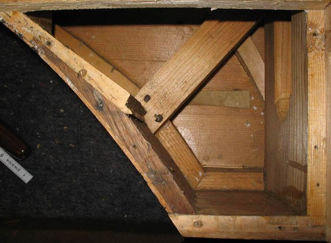

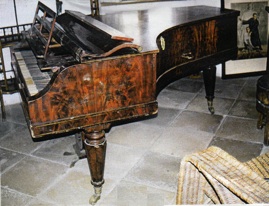
Over the past 18 years I have restored fortepianos by Fritz, Jakesh, Müller and Heichele, but the most spectacular would be the two restorations of pianos by Conrad Graf. Both instruments - one without opus number, but from 1824/25 and the other one opus 2738, ca.1839 - were shortened at the end of the 19th century, by no means an unusual practice. The instruments were probably over-strung at some point and their cases warped. Someone - in the case of the earlier piano the Czapka firm in Vienna in 1893 - cut off the tail, reused the end of the bent side as a new and much wider tail, added a metal hitch rail plate in the tail and an extra metal bar over the existing gap spacer. The action was refurbished and the instrument sold as a useful, if rather old-fashioned 'grand' measuring 175 cm. I found the earlier instrument stored in a basement in Vienna in 1985 and opus 2738 was found in the Czech Republic in 2001, the latter had been kept in playing order at least until 1976.
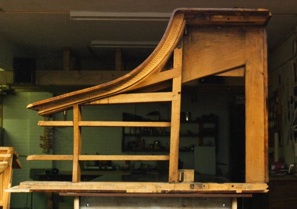
The case of the 1824/25 instrument had to be completely dismantled. During this process the many clever improvements Graf had made to the construction in order to make it more stable and durable were revealed. In order to prevent common problems such as cracked or loose hitch rails, loose wrest planks or yokes that had become unglued, Graf had laminated the curved part of the hitch rail to prevent splitting. Additionally, the wrest plank was secured with two huge bolts and the manner in which the yoke and the two arms are connected improved the stability even further. The diagonal stiffener - a crucial part of the frame that should prevent the cheek from moving upward - ran all the way towards the front and was made of pine instead of the expected spruce. Many parts were veneered and finished before they were glued to the frame: a clever labour-saving method.
The laminated inner construction made it relatively easy to extend or replace the original frame members. The wrest plank had to be replaced but I reused the original veneer. The soundboard was taken apart and the individual shortened planks were extended with a scarf joint above a rib.
The 1839 instrument was a much sturdier construction. The inner frame members ran to just a few centimetres under the soundboard and were let in to the spine and bent side for about half an inch and wedged in place. By this method the layers of the spine and bent side are not 'broken' by the cross members, making the outer parts of the frame much stronger. Graf used butterfly shaped inserts of beech which are let in to the top surface of the wrest plank to prevent splitting.
Opus 2738 must have been a very expensive instrument. The legs, lyre, music stand and inner cheeks have decorative brass inlays and the instrument is veneered in Cuban pyramid mahogany. It resembles very much opus 2787, the instrument seen in Dannhauser's painting of Liszt among his friends, now in the Kunsthistorisches Museum in Vienna.
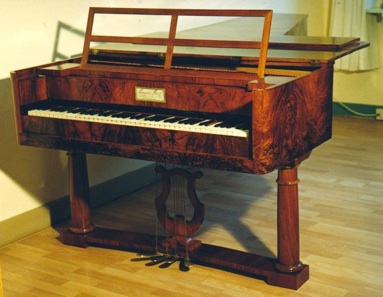

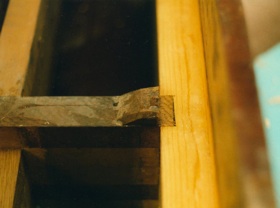
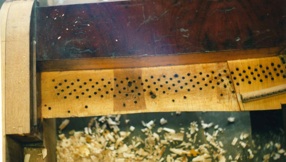
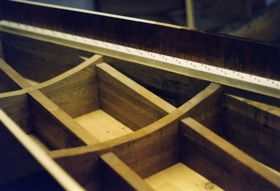
Johann Augustin Straube (1725, Alt Brandenburg - 1802, Berlin) was praised by Forkel in his 1782 Almanach for the quality of his harpsichords and square pianos. No such instrument by him is known today, but three clavichords have survived. Two instruments with a soundboard that extends over the whole area inside the instrument can be found respectively in the collections of the Gemeentemuseum, The Hague and in the Grassimuseum, Leipzig. A third one with a normal soundboard from the collection of the Märkisches Museum is in Schloß Friedrichsfelde in Berlin.
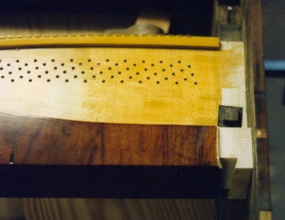
At some point in its history, the soundboard of the 1783 instrument was removed. It was simply cut out near the liners and along the front of the wrest plank. In two sections a layer of old soundboard wood was glued underneath the board - successfully making the sunken board flat again - but obviously killing the sound. Many cracks in the board were poorly shimmed and covered with strips of leather. Unfortunately, a delicate and resonant section in the high treble of the soundboard above the wrest plank was separated from the main board. I reconnected the two parts by a thin piece of spruce under the board and removed extra layers of sound board wood, as well properly repairing all the cracks. Many of the horn plates that guide the keys at the back had been replaced by small strips of all sorts of sheet metal, damaging the edges of the slots in the guide rail. The sharp edges were rounded and the slots repaired.
The inaugural concert - a recital by Gustav Leonhardt - took place at the museum in April 2010.
A typical feature in the design of the instrument is the position of the tangents. They are not placed in a straight line as usual, but their line forms a slight 'S'-curve. It seems at some point Straube moved the outer strings away from the stiff edges of the sound board, probably to improve the singing quality of the extreme treble and bass.